There is a concern that banks have stopped lending. Is this because there are no solid borrowers or is it because lenders have lost faith as a result of arbitary changes to property rights and bankruptcy laws?
Banks will not advance money if they no longer see the equity of the borrower taking the first hit. If there is no first hit to be taken, then the banks must assume that they are pari passu with equity holders.
The main problem facing markets is that banks are facing immediate heavy losses arising from derivative financial contracts. Banks balance sheets are not designed for catastrophic losses of equity, but they can absorb up to 10% to 15% total losses on their loan book over say 5 years. This is equivalent to a 50% to 66% recovery on a bad loan book equivalent to 30% of the total loan book. Banks with non-performing assets = 10% of total assets will struggle. If the ratio reaches 20%, the bank will most likely fail.
For example, assume a typical bank with common equity of 6% of assets and a pre-tax, pre-provision ROA of 3.5%. If in any one year 15% of the loan book is non-performing then ppROA will fall to say 3%. Provisions and losses at 33% of these NPA reduce overall ROA to 0% and eat into equity to the value of 2% of assets, reducing equity to 4% of assets. The bank has an equity issue of say 1 new share for every one held but as the Price to Book Value will be <<1.0x, say 0.5x, the equity base only recovers to where it was before, at 6% assets.
If the same happens the following year, then shareholders will once again need to chuck money at the bank equivalent to 2% of the asset base until the problem eases.
But if I don't recover 67cents on the dollar and/or if the NPA ratio is higher, then the equity will be depleted by much more than 2% of the asset base. In addition, the ppROA will be adversely impacted by funding costs and the price to book ratio, ahead of the new share issue, will be even more bleak.
The forthcoming settlement of AIG, Fannie & Freddie, and Lehman CDS contracts means that we will get some market clearing prices on the bad assets. Then buyers and suppliers of capital will magically reappear because the calculations outlined above can be done with more certainty.
However, bank recapitalisation also requires time. As alluded to above, banks take the hits year by year and that is because the work out of loans or recovery of collateral are also time consuming processes. Furthermore, as these bad loans were "held to maturity" assets, and thus valued with some discretion, the banks had a chance to blend internally generated capital and external equity injections to restore the bank to rude health.
By contrast, the upcoming CDS auctions could be traumatic as we are trying to estimate in a few days the recovery value of the assets and the liabilities of four intertwined businesses. This is before the people now controlling the failed entities have barely started work on assessing the real assets of the businesses.
Unfortunately there is massively more value in the CDS being settled by auction than there is in the real assets of the business. Maybe 10x more derivatives traded than underlying assets, maybe much more. Mispricing the CDS values by 5cents on the dollar is equivalent to being 50% wrong on the value of the real assets.
But unfortunately the market price established will need to be used by the banks and this will almost certainly throw up some permanent impairments to their "held to maturity" loans. The chance for banks to smooth their way back to profits will have disappeared.
There seem to be three routes forward assuming banks remain in the private sector;
i) BIS and/or Fed relax the banks' capital criteria,
ii) another major overhaul of mark to market accounting is required or
iii) creditors take equity.
The purest route forward to offset the instant value destruction derived from the CDS auction would seem to be the creation of instant equity. In other words, there must be a mechanism for the instant swap of debt for equity.
But such changes cannot happen if governments have guaranteed all non-consumer deposits and liabilities, or if indeed the government has already split the balance sheet up.
As noted earlier, banks, in effect, already believe that they are no better off than equity holders which is why they are not lending. However, it is not the uncertainty of the credit market that makes holding equity unattractive but the unpredictability of government actions with respect to any holder of a bank liability.
At least with another bank's equity in their pockets, a bank then owns (albeit a very large amount) a homogeneous, transparently-priced security for which there is a liquid market - as long as the government doesn't interfere.
And finally, the conflict between going concern principles and fair value accounting can, in my view, best be resolved if liabilities are valued at the higher of par or market value. (Pension liabilities should be discounted at long-term government bond yields). There would need to be a balancing quasi-financial asset, but at least the ridiculous state of affairs where a struggling bank can show an enhanced equity valuation because the market discount to par of its own capital instruments are credited to equity, would disappear.
Invexit
Wednesday, 1 October 2008

Friday, 19 September 2008
Investment bank advice to Fed - SOS
Funny how, as the investment banks fell one by one, and as pressure mounted on Goldmans, the governments of the world suddenly took action. Just in time, as one of the most successful pedlars of derivatives and toxic debt products, and a master of trading and short-selling, might have gone bust.
Why governments seek advice from investment banks, the scourge of the modern world, is difficult to understand. For these banks there are yet more fees, coupled with ability to steer their clients towards maintaining loose regulation for their activities. But should not advice on the real economy, come from the commercial banks who handle real deposits and who make loans to material entities?
So instead of allowing their alma matere to be wiped out, to the future benefit of all, these government advisers decide it's time to get their political poodles to do something - save our souls.
(Invexit)
Why governments seek advice from investment banks, the scourge of the modern world, is difficult to understand. For these banks there are yet more fees, coupled with ability to steer their clients towards maintaining loose regulation for their activities. But should not advice on the real economy, come from the commercial banks who handle real deposits and who make loans to material entities?
So instead of allowing their alma matere to be wiped out, to the future benefit of all, these government advisers decide it's time to get their political poodles to do something - save our souls.
(Invexit)
Friday, 11 July 2008
Singapore's recession reporting
Singapore has been in technical recession as of the end of March 2008 and based on this week's flash estimate of Q2, GDP will have shrunk again. So has the R word featured in the media?
Press releases from the MTI steer the journalists and market players to look at growth. The magic of seasonal adjustment makes the quarter on quarter numbers still look strong while the base effect impacting the year on year, quarterly numbers keeps the increment positive. Coupled with the government sticking to its 4% to 6% growth forecast for 2008 and everyone is happy. A cynic might ask if the focus on the incremental rather than the absolute GDP numbers is in some way related to the performance linked pay of Singapore's civil servants?
Back to the numbers ...
GDP at 2000 market prices in SGD million (source ESS)
Q2 2007 57,019.4, Q3 2007 58,842.3, Q4 2007 58,538.6, Q1 2008 58,362.7.
So Q1 08 is lower than Q4 07, which is lower than Q3 07. Technical recession?
And the "good news" flash estimate for Q2 2008 is growth of 1.9%. Based on Q2 07, this actually points to a further fall in output to around SGD58.1bn for Q2 2008.
The inflation rate has "arrested" some attention in the media, which at 7.5% yoy to May 2008 is uncomfortably high and this is despite a currency being held at the strong end of its trade-weighted range. Comments on the decline in labour productivity have been few and far between. The country wants the influx of foreign workers to continue; unfortunately they are failing to stimulate the economy.
Journalists are commenting on the very low interest rates in Singapore, mainly because savings rates for depositors are at derisory levels. With a full blown recession underway, low interest rates in Singapore are desirable. Despite the minimal cost of funds, the rate of monetary growth has been declining in recent months from the >20% levels seen in much of 2007 and was down to 9.0% in the year to May 2008.
So why is money attracted to Singapore? Is it the safe haven of the East? Property prices have had a good run supported by foreign investors, but at what stage, if at all, do the investors react to the weak growth and high negative real interest rates and dump SGD assets? Can energy-intensive Singapore survive in a world of high oil and food prices? While the great man is still with us, the chances are good.
Press releases from the MTI steer the journalists and market players to look at growth. The magic of seasonal adjustment makes the quarter on quarter numbers still look strong while the base effect impacting the year on year, quarterly numbers keeps the increment positive. Coupled with the government sticking to its 4% to 6% growth forecast for 2008 and everyone is happy. A cynic might ask if the focus on the incremental rather than the absolute GDP numbers is in some way related to the performance linked pay of Singapore's civil servants?
Back to the numbers ...
GDP at 2000 market prices in SGD million (source ESS)
Q2 2007 57,019.4, Q3 2007 58,842.3, Q4 2007 58,538.6, Q1 2008 58,362.7.
So Q1 08 is lower than Q4 07, which is lower than Q3 07. Technical recession?
And the "good news" flash estimate for Q2 2008 is growth of 1.9%. Based on Q2 07, this actually points to a further fall in output to around SGD58.1bn for Q2 2008.
The inflation rate has "arrested" some attention in the media, which at 7.5% yoy to May 2008 is uncomfortably high and this is despite a currency being held at the strong end of its trade-weighted range. Comments on the decline in labour productivity have been few and far between. The country wants the influx of foreign workers to continue; unfortunately they are failing to stimulate the economy.
Journalists are commenting on the very low interest rates in Singapore, mainly because savings rates for depositors are at derisory levels. With a full blown recession underway, low interest rates in Singapore are desirable. Despite the minimal cost of funds, the rate of monetary growth has been declining in recent months from the >20% levels seen in much of 2007 and was down to 9.0% in the year to May 2008.
So why is money attracted to Singapore? Is it the safe haven of the East? Property prices have had a good run supported by foreign investors, but at what stage, if at all, do the investors react to the weak growth and high negative real interest rates and dump SGD assets? Can energy-intensive Singapore survive in a world of high oil and food prices? While the great man is still with us, the chances are good.
Wednesday, 14 May 2008
Bradford & Bingley - stewards' enquiry needed
Never mind what Steven Crawshaw said to the markets on 14th April regarding the likelihood of a rights issue, what he said on the morning of 22nd April, in the interim management statement was even more misleading. In this he comments on the capital base and funding in the same sentence but with no mention of the capital ratios being at risk.
"The first quarter of 2008 has seen excellent growth in our retail deposit base. Bradford & Bingley has a strong capital base and has funded its business activities through 2008 and into 2009. We have a focused strategy, and a business model that is adaptable to changing market conditions."
Given the deep discount of the rights issue - the new shares offered at 82p compared with the prior close of 158p - one wonders why an underwriter is needed, especially as management gives the impression that capital is not urgently needed.
The recent price movements of B&B relative to those of the other financial desperados - A&L and Barclays - suggest that a bit of window dressing ahead of this rights issue might have been underway. Have the underwriters been earning their fees? A steward's enquiry would be most welcome.
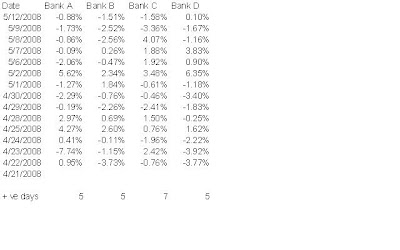
The table above takes the daily price movement (ln (Px/Px-1)). It uses using prices from Yahoo and so ends on Monday 12th. Bank A is Alliance & Leicester, B is Barclays, C is Bradford& Bingley and D is HBOS - which of course already has announced a rights issue.
And the bank with the most price rises over the fourteen days - well B&B of course.
"The first quarter of 2008 has seen excellent growth in our retail deposit base. Bradford & Bingley has a strong capital base and has funded its business activities through 2008 and into 2009. We have a focused strategy, and a business model that is adaptable to changing market conditions."
Given the deep discount of the rights issue - the new shares offered at 82p compared with the prior close of 158p - one wonders why an underwriter is needed, especially as management gives the impression that capital is not urgently needed.
The recent price movements of B&B relative to those of the other financial desperados - A&L and Barclays - suggest that a bit of window dressing ahead of this rights issue might have been underway. Have the underwriters been earning their fees? A steward's enquiry would be most welcome.

The table above takes the daily price movement (ln (Px/Px-1)). It uses using prices from Yahoo and so ends on Monday 12th. Bank A is Alliance & Leicester, B is Barclays, C is Bradford& Bingley and D is HBOS - which of course already has announced a rights issue.
And the bank with the most price rises over the fourteen days - well B&B of course.
Saturday, 9 February 2008
Premier League Irony
7th February 2008, British newspapers carry pictures and stories of the Munich air crash on 6th February 1958 and the commemorative services held 50 years later for the 23 people who died.
8th February 2008, British newspapers carry stories about the Premier League's plans to play fixtures overseas.
And I thought bankers had short memories - although memory is an inconvenience when money is involved. However, at least banks and other financial institutions now operate policies that limit the number of employees that can fly on any single aircraft - a lesson learned the tragic way by UBS as a result of the Swissair MD-11 crash of September 2, 1998.
As for the Premier League's plan, I haven't even started on carbon footprints, the potential alienation and loss of domestic audience etc.
8th February 2008, British newspapers carry stories about the Premier League's plans to play fixtures overseas.
And I thought bankers had short memories - although memory is an inconvenience when money is involved. However, at least banks and other financial institutions now operate policies that limit the number of employees that can fly on any single aircraft - a lesson learned the tragic way by UBS as a result of the Swissair MD-11 crash of September 2, 1998.
As for the Premier League's plan, I haven't even started on carbon footprints, the potential alienation and loss of domestic audience etc.
Friday, 8 February 2008
Where next for AAA ratings?
As the rating agencies announce reviews of their methodologies, it goes without saying that there will be more tinkering and more rating scales rather than a return to the simplicity of the single trade-based credit scale borrowed by the original bond rating agencies.
The main problem is that AAA is not what it says on the label. Obviously therefore, "AAA" should be sub-divided into AAA1, AAA2 and AAA3. This would give the agencies more potential rating moves on which to comment and users of the ratings would then be aware of which entities were "weakly positioned in the AAA range" rather than simply being a "risk-free" investment.
However, some might feel that, like the UK's school examination system, this is a dumbing down of the top standard. A solution to this concern would be to create "AAAA", the new top standard which, in polo shirt-sizing jargon, we could perhaps call "4XA".
Alternatively, we could introduce the prefix "s" to a rating thus adding to the existing 30+ rating scales that Moody's, for example, currently operates. The "s" would stand for spreadsheet and would alert investors to the fact that the ratings have been derived from models recently dreamed up by quant PhDs and the newly created entities are simply boilerplate companies run by small back office teams. These "s.AAA" ratings could then be distinguished from earned, tangible AAA ratings. How can a CDO be sensibly compared to the likes of Germany, Singapore, General Electric and Toyota, whose enduring managements can demonstrate a 15+ year track record of consistent performance and, in the case of the two companies, are supported by net worth of over $100bn.
And what of the USA? Investors have accepted AAA as representing the "gold standard" of ratings and US Treasuries, rated AAA, are the ultimate risk-free investment, Unfortunately foreign currency-based investors in money-good UST have still lost some 7% p.a. over the last seven years when the USD is measured against a global basket of currencies. Perhaps if the USD currency was a reliable store of wealth and behaved more like a gold standard then the quality of the rest of the USD-based financial system might also improve.
The main problem is that AAA is not what it says on the label. Obviously therefore, "AAA" should be sub-divided into AAA1, AAA2 and AAA3. This would give the agencies more potential rating moves on which to comment and users of the ratings would then be aware of which entities were "weakly positioned in the AAA range" rather than simply being a "risk-free" investment.
However, some might feel that, like the UK's school examination system, this is a dumbing down of the top standard. A solution to this concern would be to create "AAAA", the new top standard which, in polo shirt-sizing jargon, we could perhaps call "4XA".
Alternatively, we could introduce the prefix "s" to a rating thus adding to the existing 30+ rating scales that Moody's, for example, currently operates. The "s" would stand for spreadsheet and would alert investors to the fact that the ratings have been derived from models recently dreamed up by quant PhDs and the newly created entities are simply boilerplate companies run by small back office teams. These "s.AAA" ratings could then be distinguished from earned, tangible AAA ratings. How can a CDO be sensibly compared to the likes of Germany, Singapore, General Electric and Toyota, whose enduring managements can demonstrate a 15+ year track record of consistent performance and, in the case of the two companies, are supported by net worth of over $100bn.
And what of the USA? Investors have accepted AAA as representing the "gold standard" of ratings and US Treasuries, rated AAA, are the ultimate risk-free investment, Unfortunately foreign currency-based investors in money-good UST have still lost some 7% p.a. over the last seven years when the USD is measured against a global basket of currencies. Perhaps if the USD currency was a reliable store of wealth and behaved more like a gold standard then the quality of the rest of the USD-based financial system might also improve.
Thursday, 10 January 2008
Rating agencies are USD muppets
For too long the rating agencies have dished out foreign currency ratings with the USD deemed as the ultimate foreign currency. While sovereign rating analysts are quick to point out the failings of emerging market economies that adopt poor economic, fiscal and monetary policy and which often lead to a depreciation of the local currency against the USD, the 7% annual loss for the last six years in the USD against a global currency basket has been conveniently ignored. For global investors, the USD depreciation has been a major loss of value.
Of course, printing money to destroy its value is the way for any government to reduce the burden of debt, but the global rating agencies do the world a disservice if they only look at life through greenback tinted spectacles.
While rating agencies have sought to distance themselves from valuation, all their models for structured finance, work backwards from an assumed valuation or recovery given default. Thus while many AAA rated obligations have been downgraded, few have defaulted - the downgrades generally representing the risk of greater loss.
So Moody's et al, hurry up and downgrade likely value destruction wherever it is. There is no excuse not to use a global currency index; if spreadsheets can support your quantitative risk models, running a foreign currency basket programme is a doddle. If foreign currency ratings aren't based on the most reliable currency benchmark (absent a gold standard) then outcomes too will be second rate.
Of course, printing money to destroy its value is the way for any government to reduce the burden of debt, but the global rating agencies do the world a disservice if they only look at life through greenback tinted spectacles.
While rating agencies have sought to distance themselves from valuation, all their models for structured finance, work backwards from an assumed valuation or recovery given default. Thus while many AAA rated obligations have been downgraded, few have defaulted - the downgrades generally representing the risk of greater loss.
So Moody's et al, hurry up and downgrade likely value destruction wherever it is. There is no excuse not to use a global currency index; if spreadsheets can support your quantitative risk models, running a foreign currency basket programme is a doddle. If foreign currency ratings aren't based on the most reliable currency benchmark (absent a gold standard) then outcomes too will be second rate.
Subscribe to:
Posts (Atom)